sterlingmining

Our History

History

1903 - 2010
1903 - October 1998

Sterling Mining- Founded in Wallace , Idaho

 1903 – October 1998

 Founded by John Presley. The Company initially staked the East-West Link claims. In the first 30 years, early exploration included the driving of six tunnels onto the property. In 1951, Day Mines and later associated entities leased the key Sterling property for exploration purposes. The    Company was financed in the typical fashion of the time by assessing shareholders for funds; if shareholders did not pay shares were be forfeit and sold at auction.

 The Company’s stock began trading on the Spokane Stock Exchange, and when the exchange closed in 1991 Sterling Mining stock began trading on the Over-the-Counter market.

 In 1996, Coeur d’Alene Mines Corporation (through a subsidiary) leased the original Sterling East-West link claims.

John Swallow was appointed President of Sterling Mining Company, and negotiated a merger agreement with private Ashington Mining Corporation headed by Raymond De Motte

 November 1998 – May 2008

Sterling Mining Company through a share exchange acquired the Ashington Mining Corporation at a time when Sterling Mining Company’s stock price was $.25 per share. The President of Ashington Mining Corporation Raymond De Motte became President of Sterling Mining Company.

The Company began an aggressive campaign to acquire additional mining claims in north Idaho in the Coeur d’ Alene Mining district, and the JE prospect Montana. 

2003:

In 2003 it acquired a lease with option to buy the Sunshine Mine. Former President John Swallow played an important role assisting Ray De Motte in the transaction. Sterling Mining Company’s stock price increased by several thousand percent, making it the best performing silver mining stock of 2003.

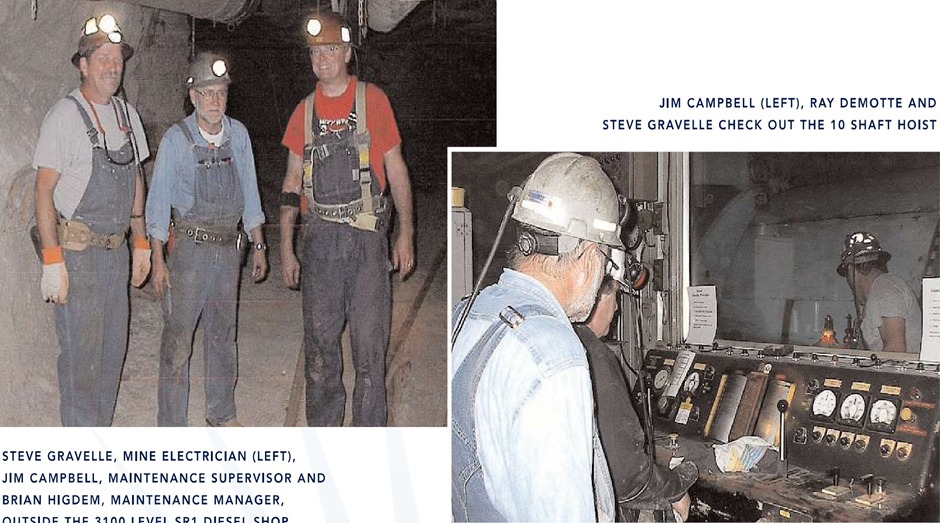
Former Sunshine Mine manager Micheal Mclean was hired, and Sterling Mining established a priority of hiring former Sunshine Mine personnel wherever possible to gain the expertise and experience of those who had run the mine before.

Raymond De Mote and Michael Mclean developed a three Phase Plan to rehabilitate and prepare Sunshine Mine facilities for a return to production at the start of 2008, and a three-phase conceptual mine plan to guide operations and prepare for an independent NI43-101 report to support financing and listing on a major stock exchange.

After taking over the property, Sterling personnel began inspecting and prioritizing work to be done to minimize deterioration of facilities that had not been maintained and return them to safe, fully operational status. Being one of the pillars of the operation, work was started on the Jewell Shaft hoists to ensure the soundness of both the double-drum production hoist and the single-drum “chippy” hoist used for moving personnel and supplies.

Sterling Mining and Raymond De Motte were primary sponsors behind the establishment of the Silver Summit Investment Conference in Coeur d’Alene and Wallace Idaho, which became an annual event for silver investors, companies and analysts.

2004:

In Mexico:

Sterling began operating in Mexico, with the acquisition of Baroness Silver Project in 2004. It was the first environmentally-safe thiosulphate project in Zacatecas. Sterling’s President Ray De Motte and in Mexico General Manager the late Martin Sutti, spearheaded development in Mexico. Sterling Mining de Mexico was formed, with Gilverto Zapata as CFO.

At the Sunshine Mine:

In April 2004, Phase I of a comprehensive Conceptual Mine Plan was completed which broadly defined the parameters, operating criteria and costs that would be involved to return the Sunshine Mine to production

 By the end of April 2004, both hoists were re-conditioned and operational. An experienced crew re-established shaft signals and communications to allow inspection of the Jewell Shaft to the 3100 level (-427 ft, sea level). After determining the fitness of the shaft, key personnel were able to be lowered to inspect underground.

2005:

At the Sunshine Mine:

Phase Il of the Conceptual Mine Plan was completed in late March and subjected to a final internal review in April. The Phase Il study was meant to both verify projections and outline a schedule of activities and costs during Phase Ill to prepare for production and necessary financing.

Phase Ill, commenced, focusing on “fine tuning” the mine plan and providing more detailed engineering for evaluating water treatment and tailings management options. In addition, inventories of mine-wide mineralization are being categorized along with an in-depth analysis and prioritization of several significant underground exploration opportunities. Critical path elements and work were constantly being reviewed and progress tracked.

In December 2005, Behre Dolbear & Company, an internationally recognized engineering firm was retained to review work by the Sterling staff and facilitate moving the Conceptual Mine Plan forward

In Mexico:

Development of the Baroness Project completed and initial test production commenced; Sterling Mining de Mexico acquired additional mining prospects including a lease with option for the San Acacio Mine. Sterling Mining Company steadily increased its land position in the Zacatecas Silver Mining District,

Corporate:

In September 2005 Sterling Mining again was a key sponsor of the annual Silver Summit investment conference held in Coeur d’Alene and Walace, Idaho.

In late 2005 a frivolous lawsuit was filed by a shareholder, which ultimately was dismissed with prejudice by a Federal Judge.

In December 2005 Sterling Mining filed with the Securities and Exchange Commission in America to become a public reporting company to prepare for another exchange listing and institutional financing.

Sterling Mining Company began discussions with the owner of the Bunker Hill Mine on a long-term strategic plan to advance production at the Bunker Hill Mine.

2006:

At the Sunshine Mine:

Sterling’s three phase internal conceptual mine plan complete and the prestigious mineral consulting firm Behre Dolbear began work to prepare an independent technical report. During 2006 additional operating personnel hired, ordering underground diesel equipment, and preparation activities at the 2700 and 3100 level for a return to production.

In Mexico:

The Baroness Project increase production, Sterling Mining de Mexico acquired a crusher to process material from the San Acacio Mine at the Baroness Facility.

2007:

Behre Dolbear NI43-101 Technical Report for the Sunshine Mine was completed in April 2007.

Sterling Mining Company engaged in a road show in support of a $24 million fund raising to complete final preparations at the Sunshine Mine and provide working capital to re-start production. Investors included Goldman Sachs, along with investors from the United States, Canada, the United Kingdom and Europe.

 In the fall of 2007 Sterling Mining Company secured a listing of its stock on the Toronto Senior Stock Exchange. In December 2007 Sterling Mining Company began shipping silver concentrate from the Sunshine Mine meeting the start timeframe of the three Phase plan adopted in 2003.

2008:

 Delays in ramping up production at the Sunshine Mine led to a requirement for additional capital. Sterling’s investment banker and Raymond De Motte secured Preferred Stock financing from source in London, United Kingdom at $4 a share, but the directors turned down the proposal. A Canadian listed company introduced by Sterling’s investment bankers met with Sterling’s directors, proposing to merge the Company and had sufficient capital to build production at the Sunshine Mine- Sterling’s directors turned down this as well.

June 2008 – April 2010

May 28, 2008 – April 2010

Ken Berchst was appointed President at the end of May 2008.

New management and the directors became embroiled in poor relations and disputes not only  with outside parties such as Sunshine Precious Metals  the leaseholder of the Sunshine Mine, and even the management of Sterling Mining de Mexico. The prior cordial relations disappeared.

The company incurred fines from the EPA, and inexplicably the accounting department overlooked paying royalties to the Coeur d’Alene Indian tribe resulting in additional financial claims.

Minco Silver on July 22, 2008 announced it would merge with Sterling Mining Company. Under the terms of the Transaction, Minco Silver offered  0.51 of a share for each one Sterling share which equates to an offer of US$1.58 per Sterling share based on Minco Silver’s July 21, 2008 closing  price. The offer valued Sterling at US$62.3 million. Upon completion of the Transaction, the combined company would have had approximately 52  million common shares issued and outstanding, plus options and warrants. Minco Silver shareholders would have had 61% and former Sterling  shareholders would have had 39% of the combined company.

Minco Silver extended a US$15 million line of credit to Sterling, of which US$5 million is to be funded immediately, bearing 10% annual interest compounded monthly, to be used for continued operations at the Sunshine Mine.

Minco Silver had found it difficult dealing with the Sterling corporate officer and directors, including an initial visit to Sterling’s corporate officers being told “there was no mine plan”. Minco then discussed lowering the price to the $.80 per share with a key Sterling director rejecting even though Minco was offering to finance the ongoing operations.

September 2, 2008 Minco announced it decided not to proceed with the acquisition.

By the end of September 2008 operations at the Sunshine Mine were shut down.

2009 witnessed continued confusion and disagreements between Sterling Mining and the Sunshine leaseholder Sunshine Precious Metals, potential acquirers of the mine SNS Silver, as well as Minco Silver seeking repayment of funds advanced to Sterling Mining. Numerous disputes were submitted to the bankruptcy court for resolution.

On January 12, 2009 John Ryan was appointed President of Sterling Mining Company.

On January 23, 2009 Sterling Mining President John Ryan announced Sterling Mining had sold its Sterling Mining de Mexico subsidiary for $240,000.

In February 2009 Director Roger van Voorhees was named President of Sterling Mining Company. Voorhees then proceeded to have Sterling Mining  Company to file bankruptcy. Voorhees along with fellow Director Carol Stephan, and the former CFO, had been instrumental in blocking the January 2008 financing , blocking the merger with Minco, and the internal coup that led to new management at end of May 2008.

Negotiations with Canadian company Alberta Star Development Corp. leading to Alberta Star announcing it would acquire a controlling interest in  Sterling Mining Company. Subject to approval by the bankruptcy court led nowhere,

On April 22, 2010 Sterling Mining announced the results of the bankruptcy auction that Silver Opportunity Partners had acquired the assets of  Sterling Mining Company for $24 million dollars which included payments to creditors and $.06 per share to Sterling Mining shareholders. 

2010

Silver Opportunity Partners acquired Sterling Mining Company in bankruptcy auction for $24 million dollars, Sterling Mining Company shareholders received $.06 per share.

 2010 – Current

 Silver Opportunity Partners reported in 2026 over 100 million dollars have spent on further exploration and development on the mine in preparation  to returning to production of the famed Sunshine Mine.

The land package assembled by Raymond De Motte in the Coeur d’Alene Mining District has largely been maintained by Silver Opportunity Partners, now going by Sunshine Silver Mining and Refining.The Company is well-financed and with professional management.

In Mexico many of Sterling Mining’s projects have been optioned or leased to various junior mining companies.

Lorem ipsum dolor sit amet, consectetur adipiscing elit. Ut elit tellus, luctus nec ullamcorper mattis, pulvinar dapibus leo.